Friday, March 17, 2017

That Crazy Fly

Happy St. Patrick's Day. I hope you are enjoying you Irish Bangers for breakfast with some lovely fried potatoes...and may your corned beef dinner be the best.

This is a post about a crazy fly and the day's of last April fishing it. I hope you'll enjoy the change in scenery, Spring as opposed to Winter which is getting very old.

I may attempt to get out on the water today and perhaps manage to bring one of these to hand...using that crazy fly.


My corned venison is about a day away from being fully cured. I'm slated to enjoy it on Sunday...stay tuned.


Wednesday, March 15, 2017

"In A Different Light"

Do fish see colors? That's a question I've heard talked about since the day I tied on a fly over 30 years ago. My answer has been no, but the argument can be made that it's yes simply because if the fly your fishing is dark and what's on the water is light chances are your dark fly will be rejected. Now I grant you this is a very simple explanation, and there are so many other things at play that will cause a fly to be rejected.

Below I have tested a few soft-hackles and spiders in a glass of water to try and simulate what a fly looks like in it's emerging stage. I've used various patterns, all different accept for the first two. This little experiment shows some pretty big differences in how a trout looks at a fly.


The first two flies are partridge and orange patterns, the same exact fly. You can see the orange silk body showing through the very sparse dubbed body. Also visible are the tiny air bubbles trapped in the dubbing and along the hackle fibers.


This is the exact fly as the first. Notice when photographed in a different light the fly looks totally different, especially the color. The trapped air bubbles are more pronounced and the body color takes on a different light.


This is a partridge and orange tied without any dubbing. This fly has a slight-sparse thorax and partridge hackle. The trapped air bubble is highly visible.


You can also see a very distinct rib in the body. This is accomplished by winding just the silk thread. It is not clear in the photo but those ribs in the thread catch light an act as another attraction.


In this last photo the fly has a fully dubbed body, it is slightly tapered and has a gold tinsel rib. Naturally the tinsel rib will draw attention but the key is the almost perfect ribbing in the body showing an insects natural segmented body.

A key to all of these flies is the soft-hackle....it's alive.


Monday, March 13, 2017

In The Land Of Zane Grey, Rivers, and Flies

Back in the mid eighties I started hunting in the state of Pennsylvania. We primarily hunted deer but the license came with a spring turkey tag which allowed us to hunt wild turkey's. The spring season pretty much encompassed the month of May which is about as good as it can be, I mean cool mornings, which is the time of legal hunting, have to be out of the woods by 1PM, and the afternoons and evening were for the most part very comfortable. So I'm in Pennsylvania with a free afternoon-evening and nothing to do. The light came on and soon a fishing license was purchased and that opened up something to fill said time.

There was a wonderful river that flowed close to the game land I hunted, it's name is the Lackawaxen. A fairly long river and at times a big fast flowing river. The area I would normally fish was a power control river, they would generate and the flows would increase and then the river would return to normal flows. The river was stocked and I am pretty sure it also had some wild fish.


Along its banks was a fishing shop, fly shop and a place where you could get some very valuable info on what was going on. On one trip to the river I stopped in and talked to the gent in the shop. The river had been good to me as far as catching fish. I was armed with the necessary flies and pretty much thought that was all that was needed. At the time I was not tying my own flies so when he suggested I try these which he referred to as "emergers" to quote him "there the best producers here". So I purchased several of them and went about my way. Making a long story short they were indeed the finest fly production wise I ever bought. An example "make ten casts and you had three hits" usually leading to a fish. This ratio was not always the norm but it was close.


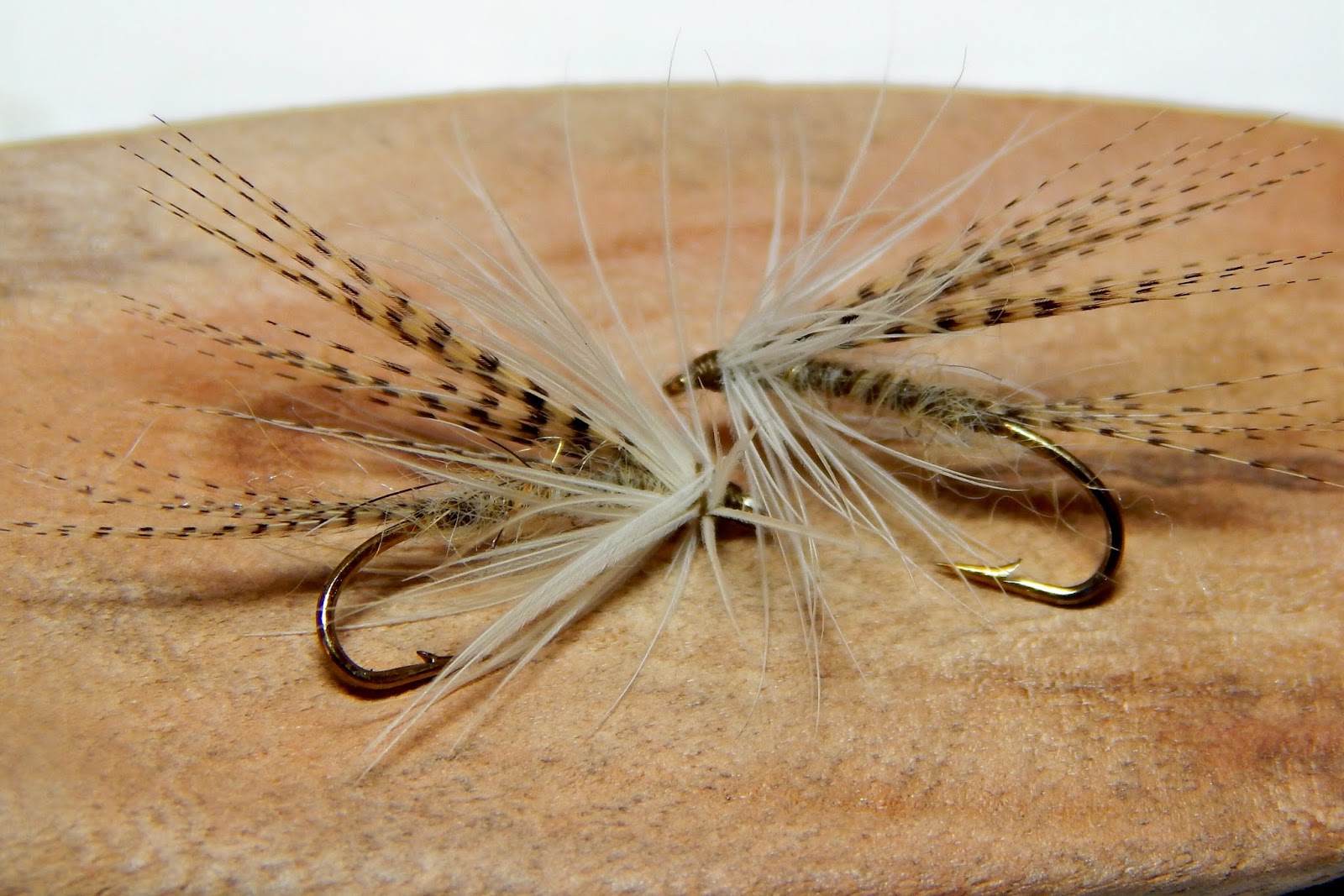
This is that fly, as I remembered it. It's tied on a slightly different hook, for I don't think these hook were available. I do remember it was a log shank hook though.


This last fly was tied on a standard dry fly hook just to show a difference from the longer shank hook.

I don't know if the shop is still in business, for the last time I was there was in 2011.


Saturday, March 11, 2017

Moby Dick...the Classic

"Moby Dick" the Herman Melville classic that was required reading by my generation...there I go aging myself. But i was one of those non-conforming students who thought the movie was much more enjoyable. It was released around 1956 and starred Gregory Peck. It was a great movie and probably can be seen on Turner Classic Movies.

This is the other "Moby Dick"..the fly. It was created by Dave Goulet of Massachusetts and former owner of the Classic and Custom fly shop in New Hartford CT. The fly was originally intended to be a streamer, but I have seen it fished as a dry, and a wet fly. Ken Elmer a guide in MA. ties and fishes it has a wet fly, with considerable success. I favor it tied as a small streamer pretty much as the original. This fly is deadly and is the one fly to fish on CT's Salmon River where for some reason the trout just attack it.


Here's the recipe for this "not to often mentioned killer fly"

Hook, Mustad 38941 #10...Tail, golden pheasant tippets...Body, peacock herl...Hackle, brown...Wing, mallard flank.


The frittata....an Italian egg cake. That's what my old boss and mentor called it back when I first enjoyed it in 1968. Simple and filling, it's basically eggs and anything else you have.

This one has mushrooms, onions, spinach and grated Romano cheese.